Ostraka
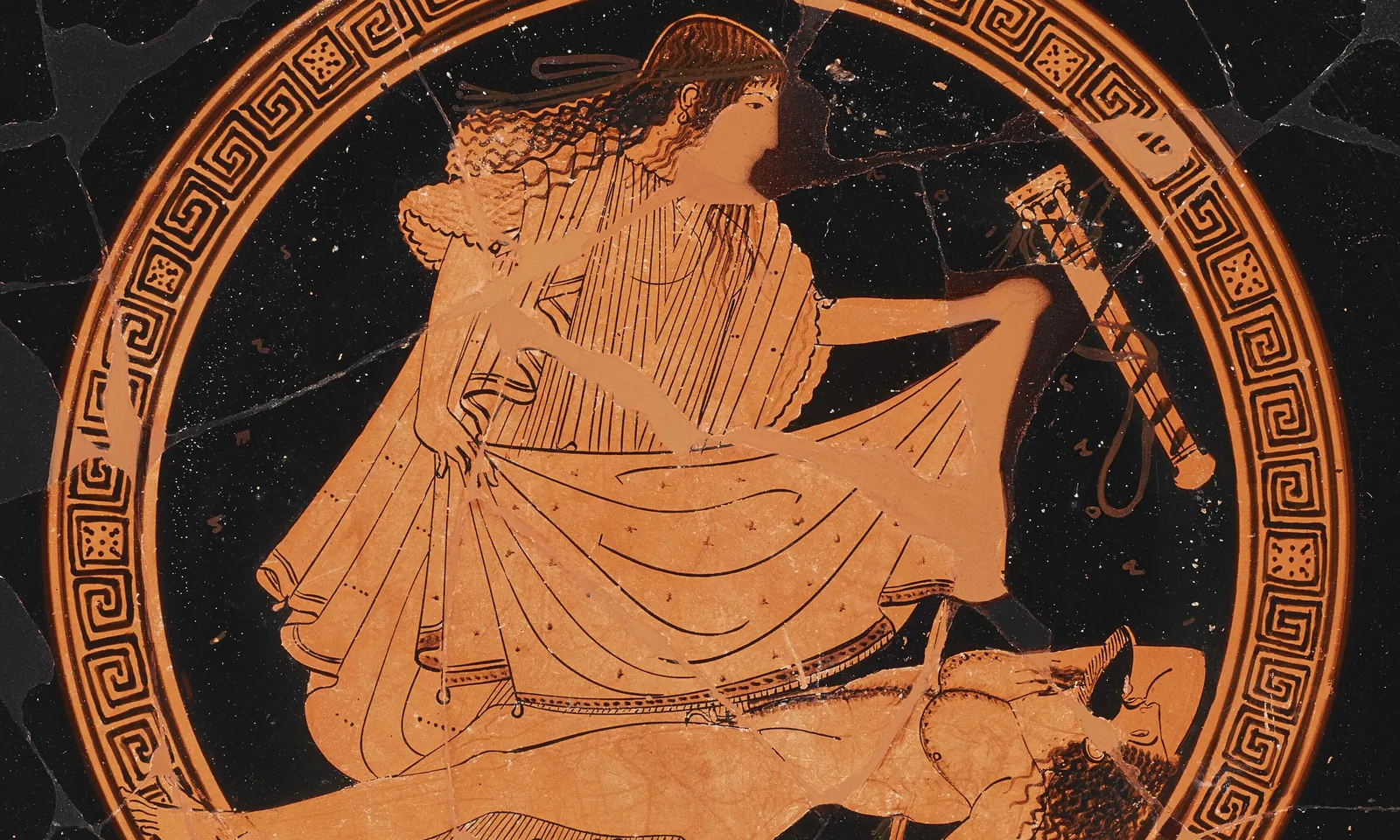
A fragment of a red-figure cup painted in Athens about 490 BC: two figures inside a meander border

Learn to read Ancient Greek

Homer, Iliad 1.1–2. Tap any word.

An iPhone and iPad app for reading Homer, Plato, Aesop and the New Testament in Greek, with every word one tap from its grammar.

Coming soon to the App Store

See what’s free

Tap any word

Every Greek word in Ostraka, in lessons, texts and games, opens a card with its dictionary form, its parse, its meanings and its paradigm.

The card names the form in plain English, aorist active indicative, 3rd person singular, each part in its own colour: case, tense, mood, voice, person and number.

A short definition first, then the senses of Liddell–Scott–Jones, and the whole entry when you want it. Logeion, Wiktionary and Perseus are one tap away.

The full paradigm by tense, voice and mood, with the form you tapped outlined, and the principal parts of every verb. Save the word and it returns in your daily review.

Dictionary entries
110,000+
Analysed word forms
240,000+

Made for reading

The reader is the centre of Ostraka. Everything else, the lessons, the games, the review, leads back to it.

Interlinear, when you want it

Turn on the glosses and every word carries its meaning underneath. Add the parse too, or switch both off and read clean. Each sentence’s translation is a tap away.

Every form, in its table

Declensions and conjugations by tense, voice and mood, the form you tapped outlined. More than 4,000 words carry their complete paradigms, checked against the morphology of Perseus.

Paper by day, glaze by night

A light theme like a sunlit catalogue page, and a dark one like black-figure pottery. Ostraka follows the appearance of your iPhone or iPad.

Thirteen units, start anywhere

76 topics from the alphabet to Homer’s hexameter, each with a lesson, practice and a reading. Nothing is locked behind the topic before it. Units 1 and 2 are free.

Real texts, in Greek

Not sentences made up for a textbook: Aesop, Xenophon, Plato, the New Testament, Marcus Aurelius, Homer and Aristotle, annotated word by word, so every word opens its card and every sentence its translation.

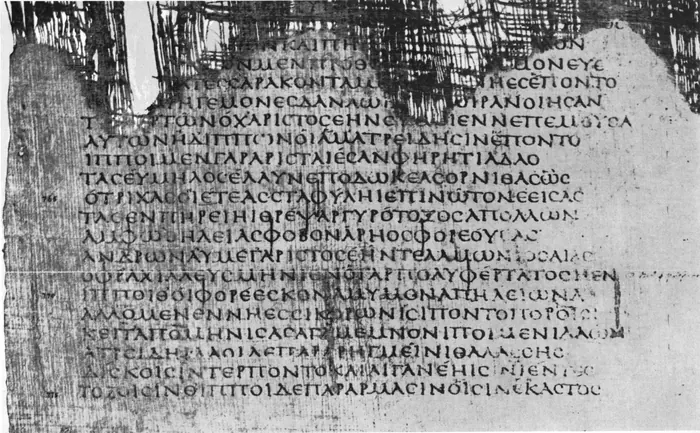
A papyrus of the Iliad from Hawara in Egypt, written in the 2nd century AD in Greek capitals
The Iliad on papyrus, Hawara, Egypt, 2nd century AD. Ostraka sets the same words in a modern polytonic text.
HomerὍμηρος5 texts

The openings of the Iliad and the Odyssey, in the epic Greek of the oldest poems of Europe. 1,082 words in all.

  • The wrath of Achilles168 words
  • Chryses' prayer and Apollo's arrows199 words
  • Achilles calls an assembly361 words
  • Tell me of the man148 words
  • The gods in council206 words
Aesop's fablesΑἰσώπου μῦθοι52 texts

Short animal fables with a moral, the classic first reading in Greek, ordered from easiest to hardest. 2,242 words in all.

  • The lioness and the fox free26 words
  • The camel and Zeus free72 words
  • The shepherd about to enclose a wolf in the fold free27 words
  • The oxen and the squeaking axle free35 words
  • The goat and the vine shoot free32 words
  • The bear and the fox free34 words
  • The walnut tree35 words
  • The hares and the foxes34 words
  • The swallow and the raven39 words
  • The fox and the grapes37 words
  • The boy hunting locusts and the scorpion38 words
  • The dove and the crow37 words
  • The earthen and bronze pots39 words
  • The crab and its mother39 words
  • The pomegranate, the apple tree, and the bramble39 words
  • The frog physician40 words
  • The wolf and the dog in chain38 words
  • The hen and the snake eggs40 words
  • The boy and Fortune42 words
  • The hen with the golden eggs42 words
  • The kid on the roof and the wolf43 words
  • The fox and the actor's mask42 words
  • The charcoal burner and the fuller40 words
  • The flies and the honey42 words
  • The pine tree and the wedges44 words
  • The seagull and the kite42 words
  • The crow and the figs41 words
  • The wasp and the snake45 words
  • The thrush and the birdlime42 words
  • The peacock and the crane43 words
  • The deer and the lion43 words
  • The dog and the hare42 words
  • The geese and the cranes46 words
  • The shepherd and the wolf cub44 words
  • The boy bathing46 words
  • The flea and the man48 words
  • The raven and Hermes48 words
  • The sick crow46 words
  • The smith and his little dog58 words
  • The three bulls and the lion48 words
  • The heifer and the ox47 words
  • The fox and the leopard47 words
  • The bull, the lion, and the goat48 words
  • The monkey and her two babies48 words
  • The wagoner and Hercules48 words
  • The Ethiopian50 words
  • The farmer and the snake49 words
  • The dog and the snail47 words
  • The horse and the groom50 words
  • The kite and the horses52 words
  • The monkey and the camel49 words
  • The wolf and his shadow49 words
The New TestamentἩ Καινὴ Διαθήκη8 texts

Plain, direct Koine Greek: two short letters, the opening of Luke's Gospel and Paul on the life of love. 1,957 words in all.

  • The second letter of John free245 words
  • The third letter of John free219 words
  • Luke's preface42 words
  • The birth of John foretold376 words
  • The annunciation209 words
  • Mary visits Elizabeth232 words
  • The birth of John the Baptist326 words
  • A living sacrifice308 words
Xenophon, AnabasisΞενοφῶντος Κύρου ἀνάβασις28 texts

Clear Attic prose: Cyrus marches inland with ten thousand Greeks to seize his brother's throne. 8,908 words in all.

  • Cyrus and his brother356 words
  • Cyrus gathers secret armies202 words
  • The march begins356 words
  • Celaenae and the river Marsyas330 words
  • The review at Tyriaeum337 words
  • Into Cilicia378 words
  • The soldiers refuse to go on344 words
  • Clearchus' stratagem365 words
  • Clearchus declines the command348 words
  • The gates of Cilicia and Syria314 words
  • Xenias and Pasion desert337 words
  • Crossing the Euphrates374 words
  • Through the Arabian desert317 words
  • The wagons in the mud324 words
  • Clearchus and Menon quarrel274 words
  • The treason of Orontas322 words
  • The trial of Orontas281 words
  • Cyrus addresses the Greeks313 words
  • Promises and the great trench289 words
  • The king does not fight248 words
  • The king's army appears335 words
  • The battle of Cunaxa319 words
  • The death of Cyrus280 words
  • Cyrus' character: his youth332 words
  • Cyrus' justice and generosity326 words
  • Cyrus' friends195 words
  • The king plunders the camp340 words
  • The Greeks stand their ground372 words
Plato, CritoΠλάτωνος Κρίτων12 texts

Socrates, in prison and about to die, explains to his friend Crito why he will not escape. 4,276 words in all.

  • Crito's early visit284 words
  • Socrates' dream365 words
  • Crito's plan of escape386 words
  • Only the argument314 words
  • The expert and the many413 words
  • Not living, but living well362 words
  • One must never do wrong344 words
  • The Laws speak384 words
  • Country before father428 words
  • Socrates' agreement with the city318 words
  • What escape would bring363 words
  • The voice of the Laws315 words
Marcus Aurelius, MeditationsΤὰ εἰς ἑαυτόν9 texts

The emperor's private notebook: what he learned from the people who shaped him. 1,139 words in all.

  • Grandfather, father, mother79 words
  • What my tutor taught me27 words
  • Diognetus69 words
  • Rusticus and Epictetus114 words
  • Apollonius93 words
  • Sextus102 words
  • Severus100 words
  • Maximus115 words
  • What I owe the gods440 words
Aristotle, PoeticsἈριστοτέλους περὶ ποιητικῆς4 texts

Aristotle's compact, technical Greek on what poetry is and why we enjoy imitation. 1,357 words in all.

  • Poetry as imitation406 words
  • Objects and manner of imitation378 words
  • Why we enjoy imitation268 words
  • How tragedy grew305 words
Graded readingsἈναγνώσματα77 texts

Short pieces written for each grammar topic. 8,606 words in all.

  • Twelve letters, many words free24 words
  • People and places of Athens free44 words
  • A day at the theater free35 words
  • A hero at sunrise free35 words
  • Pitch makes the word free39 words
  • Diogenes and his lamp free38 words
  • Hearing the old voice free27 words
  • Sayings of the wise free31 words
  • The farmer's horse free68 words
  • The wooden horse free79 words
  • Socrates in the agora free102 words
  • The contest for Attica free90 words
  • The sailor and the soldier free97 words
  • The first day at school free75 words
  • The North Wind and the Sun free83 words
  • The farmer's treasure123 words
  • At school106 words
  • Socrates asks about colts92 words
  • The hare and the tortoise114 words
  • Two brothers128 words
  • The fox and the mask96 words
  • A stranger in the agora110 words
  • The country mouse and the town mouse163 words
  • Two friends and a bear121 words
  • The riddle of the Sphinx120 words
  • The fox and the grapes104 words
  • The shepherd who cried wolf126 words
  • Pericles and the walls133 words
  • The frogs who wanted a king137 words
  • Solon and Croesus143 words
  • The shipwrecked man127 words
  • Two brothers110 words
  • Cyrus' promises94 words
  • Xerxes whips the sea103 words
  • Archimedes in the bath100 words
  • The sea, the sea108 words
  • A schoolboy's day100 words
  • The priest's ransom119 words
  • Mutiny at Tarsus116 words
  • Croesus asks the oracle132 words
  • The death of Socrates115 words
  • The battle for the throne120 words
  • My name is Nobody128 words
  • The king himself110 words
  • Croesus and Solon156 words
  • The gift of fire140 words
  • The riddle of the Sphinx138 words
  • Narcissus151 words
  • What the gods love125 words
  • Solon and Croesus158 words
  • Archimedes in the bath145 words
  • The three hundred118 words
  • The tortoise and the hare154 words
  • The bag of winds134 words
  • Let us flee, Socrates112 words
  • A prayer by the river98 words
  • Ajax and his son105 words
  • A father's advice111 words
  • Arion and the dolphin182 words
  • The Dog and the king119 words
  • Xenophon's dream and the sneeze129 words
  • Gyges and the queen152 words
  • Doing wrong and suffering wrong140 words
  • What the oracle meant187 words
  • Gifts for mortals198 words
  • The sea, the sea149 words
  • Cyrus prepares in secret146 words
  • The ring of Gyges174 words
  • Croesus and the oracle165 words
  • The last evening of Socrates164 words
  • A sleepless night131 words
  • What must be done114 words
  • The man of many turns74 words
  • The wrath of Achilles44 words
  • The first sentence of history106 words
  • In the beginning was the Word61 words
  • The Lord’s Prayer61 words
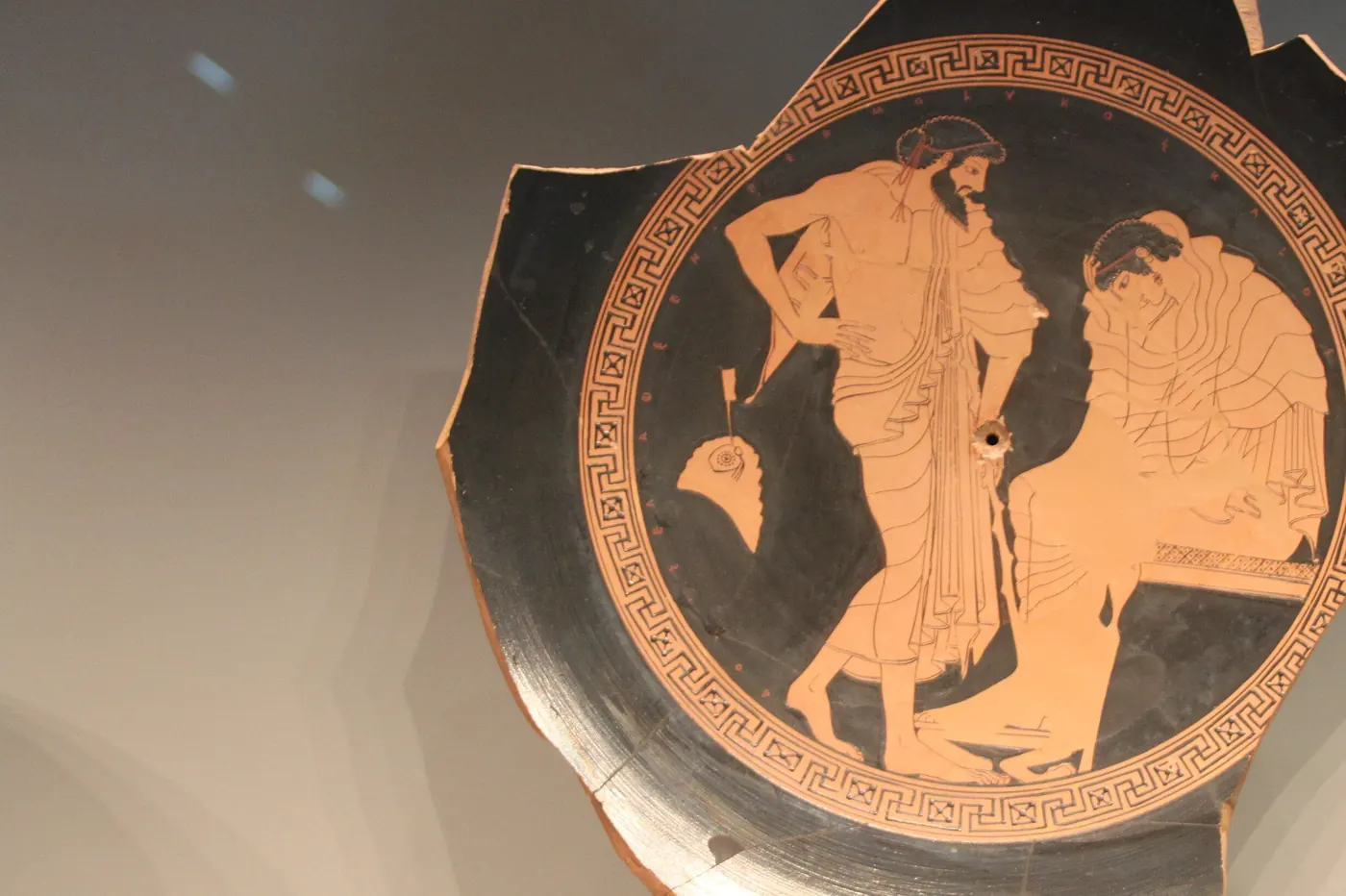
The inside of a red-figure drinking cup by the Brygos Painter, Athens, about 490 BC

Six games

Rounds of a minute or two that drill letters, forms, paradigms, vocabulary and word order, drawn from the texts you read.

Alphabet Sprint and Word Match are free; Ostraka Pro adds the other four.

An evening, counted

Lessons, right answers, readings, games and reviews all earn XP. Meet your daily goal to grow a streak; every seven days earns an olive branch that saves a missed day.

183

XP from one evening, against a daily goal of 50.

Today

  • Lesson

    • Read the lesson on the second declension20
  • Practice

    • Nine of ten exercises right, 2 each18
    • Practice score of 90%18
    • Topic completed for the first time50
  • Reading

    • Aesop, The lioness and the fox31
  • Game

    • Alphabet Sprint, score 23023
  • Review

    • Twelve cards, eleven remembered23

Total183 XP

Thirty titles, forty-four coins

Every level carries a Greek title, from Ἀρχάριος, beginner, to Ὀλύμπιος, Olympian. Achievements are struck as coins: 17 bronze, 16 silver and 11 gold, from “A first shard” to “Sing, goddess”, for finishing a passage of Homer.

  1. ἈρχάριοςBeginner
  2. ΜαθητήςPupil
  3. ἈκροατήςListener
  4. ἈναγνώστηςReader
  5. ΓραμματιστήςTeacher of letters
  6. ΣπουδαῖοςEarnest student
  7. ΦιλομαθήςLover of learning
  8. ἙρμηνεύςInterpreter
  9. ΓραμματικόςGrammarian
  10. ῬαψῳδόςRhapsode
  11. ΛογογράφοςSpeechwriter
  12. ἹστορικόςHistorian
  13. ΠοιητήςPoet
  14. ῬήτωρOrator
  15. ΣοφιστήςSophist
  16. ΔιδάσκαλοςTeacher
  17. ΦιλόλογοςPhilologist
  18. ἘπιστήμωνScholar
  19. ΚριτικόςCritic
  20. ΦιλόσοφοςPhilosopher
  21. ἈκαδημαϊκόςAcademician
  22. ΠεριπατητικόςPeripatetic
  23. ΣτωικόςStoic
  24. ΒιβλιοφύλαξKeeper of books
  25. ΣχολιαστήςScholiast
  26. ἈλεξανδρεύςAlexandrian scholar
  27. ΜουσηγέτηςLeader of the Muses
  28. ὉμηρίδηςSon of Homer
  29. ΣοφόςSage
  30. ὈλύμπιοςOlympian

Free to start

Ostraka is free to download. Ostraka Pro opens the rest of the course, the library and the games.

Ostraka Pro

Free, for good

  • Units 1 and 2: letters, sounds, the article and the first declensions, with lessons, practice and readings
  • The first six Aesop fables
  • Two short New Testament letters, 2 and 3 John
  • Alphabet Sprint and Word Match
  • Daily review
  • The dictionary, and word cards everywhere

Pro adds

  • Units 3 to 13, through participles, conditions, -μι verbs and Homer’s meter
  • All 52 fables, Xenophon’s Anabasis, Plato’s Crito, the New Testament, Marcus Aurelius, Homer and Aristotle
  • All six games, drawing on every unit

$39.99

a year for the annual plan, after a free week

  • Monthly$7.99a month
  • Weekly$2.99a week
  • Lifetime$79.99once

Coming soon to the App Store

Questions

Is this Modern Greek? No. Ostraka teaches Ancient Greek only: the Attic of Plato and Xenophon first, then Homer, the Ionic of Herodotus and the Koine of the New Testament. Every text is polytonic, with breathings and accents.

Which pronunciation does it use? Restored Attic, as Greek sounded in the 5th century BC, is the default, and Koine is a setting away. Every word has a transliteration and IPA. Ancient texts are never read aloud in Modern Greek pronunciation; where your device’s voice can’t follow the reconstruction, the speak button is hidden.

Do I need to know any Greek? No. Unit 1 starts with the alphabet. If you already know some, start anywhere: nothing is locked behind the topic before it, and onboarding suggests a starting point.

What’s free? Units 1 and 2 with their lessons, practice and readings, the first six Aesop fables, two short New Testament letters, Alphabet Sprint and Word Match, daily review, and the dictionary with word cards everywhere. Ostraka Pro opens everything else.

Where do the texts come from? From open scholarship: the Perseus Digital Library, the Liddell–Scott–Jones lexicon, Diogenes and Morpheus for the morphology, and Lyceum’s annotated texts, whose glosses and translations are partly AI-assisted. Every source is credited in the app under Sources & credits.

Does it work offline? Yes. Lessons, texts, the dictionary and games are all on your device. The internet is used only for purchases and when you open a word in Logeion, Wiktionary or Perseus.

Do I need an account? No. There is no sign-in, and your progress stays on your iPhone or iPad.

Do I need a Greek keyboard? No. Exercises and games use choices, taps and word tiles, so you never type Greek.

Which devices? iPhone and iPad with iOS 18 or later. On iPad, Ostraka uses a sidebar and the larger screen for reading.

How do I cancel Pro? In your Apple Account settings, at least 24 hours before the current period ends. You keep Pro until then. The lifetime purchase never renews.
Ὄστρακα are potsherds. Athenian pupils practised their first letters on them.

Begin with alpha

Ostraka is coming to the App Store for iPhone and iPad, with iOS 18 or later. The first two units are free.

Coming soon to the App Store